Monday, 18 March 2019

The PYREX and "pyrex" scandal

I'm just burning mad right now.

I own and use several items of PYREX brand cookware, from casserole dishes to measuring cups. I like using it. By extension, I've always respected its manufacturer, Corning Glass. I think it's good to be doing one thing and doing it really well.

What I've just discovered is that Corning switched from making cookware out of its original formulation of glass back in 1998. The original was borosilicate glass, the same type as is used in laboratory equipment. These days, it is tempered soda-lime glass. The tempering process makes this cheaper type of glass stronger, but puts extra stress on the interior. That means that, when the glass is about to break, it breaks more violently.

Corning denies that there's any danger in the new formulation, but there are lawsuits. It also says that some of its PYREX kitchenware was made from the soda-lime glass even before 1998. However, I won't buy any of the newer formulation.

Here's how you tell: prior to 1998, American-made kitchenware had PYREX (R) printed in all-capital letters; after 1998, it used lower-case. Like this:

https://cdn.shopify.com/s/files/1/1658/4831/files/Borosilicate_vs_soda_lime_pyrex_large.jpg?v=1500406309

See the difference in the trademarks?

Also, the rights to use the PYREX trademark in Europe went to the French company, Arc. It continues to make its products from borosilicate glass, and it continues to use capital letters for the PYREX  name. You can find its products here: https://icedteapitcher.myshopify.com/.

More about the switch in PYREX glass formulas:

http://nowiknow.com/the-war-against-pyrex/
https://gizmodo.com/the-pyrex-glass-controversy-that-just-wont-die-1833040962?utm_source=quora&utm_medium=referral

Sunday, 26 August 2018

Comparative Corruption in the United States and Canada

On Quora, recently, I rejected someone's idea that Canada and the United States should merge. One reason I offered is that it would leave Canada subordinate to the more corrupt of the two nations. I was challenged to substantiate my comment, but the person I was corresponding with rejected the standard measures of national corruption. Here is a lightly-edited version of my defence:
--------

Let us look at the political system in the United States for signs of corruption. The first problem it faces in being fair and free is interference elections by partisan gerrymandering.

The US ends up with electoral districts like this one:

Canada has electoral districts determined by non-partisan committees based on electoral data, natural boundaries, existing communities, and compact borders. They look like these:


In a province with fewer geographical features, they look like this:


The corrupt redistricting in the US has huge effects on the results of elections. For example, “The Brennan Center for Justice estimates extreme partisan bias gave Republicans at least 16 to 17 more seats in the 2016 election, and possibly as many as 29, according to one analysis. Democrats were 24 seats short of controlling the House of Representatives.” (Here's how gerrymandering games U.S. elections — and why this Pennsylvania decision matters | CBC News).


The second problem is ongoing efforts to disenfranchise voters on partisan grounds (New Voting Restrictions in America). These include imposing requirements for specific forms of picture ID and the closing offices in which they can be obtained (e.g. As it turns out ... Bentley's driver's license closures were racial, after all), as well as the closing of polling stations in minority districts (this story is from 2014, New G.O.P. Bid to Limit Voting in Swing States, and this one is from 2016, Opinion | The Voters Abandoned by the Court, and this one is from 2018, Georgia candidates decry plan to close voting sites in mostly black...).

In contrast Elections Canada (the independent federal agency that runs the elections) has a mandate to educate the electorate in order to increase the number of votes.

The third problem is the transparent and overwhelming influence of money on the American government’s composition and decisions. I became aware of that in the lead-up to the “Mickey Mouse Copyright Extension Act,” also known as the “Sonny Bono Copyright Extension Act.” It was an outright gift of an extra twenty-year monopoly to copyright holders or, to put it differently, a brazen theft from the public domain. Prior to that act, there were 10 extensions in 40 years, all timed to prevent the first Mickey Mouse cartoon from falling into the public domain. Now, even with a 70 or 95-year term in place, Congress is looking at extending it again (Congress' Latest Move to Extend Copyright Protection Is Misguided).

This is just one example, of course. Looking at all the data leads to the Princeton study that tested whether the United States was better described as a democracy or an oligarchy. It came down on the side that “oligarchy” was a better description (https://scholar.princeton.edu/si...).

Honestly, though, any research on the influence of the Military-Industrial Complex, pork barrelling (Pork barrel spending on the rise in Congress, watchdog group says), the Koch Brothers or the Big Pharma lobbies would lead one to the same conclusion. The endless electoral process from the primaries up to the election requires endless cash, which comes with substantial strings. In fact, American “elected officials spend 30-70% of their time in office fundraising for the next election. When they’re not fundraising, they have no choice but to make sure the laws they pass keep their major donors happy — or they won’t be able to run in the next election.” (One graph shows how the rich control American politics).

Whether the legislators are corrupt or the judges, I don’t know, but this is not a good sign of a fair and open government: The West Virginia House impeached the entire state Supreme Court.

In contrast, Canada has strict limits on personal contributions to electoral campaigns or parties, and corporations are not allowed to donate at all. Campaigns are also short. And the government provides rebates on some electoral expenses to encourage smaller parties to participate in the election and be heard.

Finally, appointments to Canadian courts, even the highest, are based on qualifications, not politics. (Why Canada's Supreme Court appointments are nothing like America's circus - Macleans.ca; Non-political SCC appointment process a welcome improvement). In most cases, a judge’s politics are not even known.

So, without referring to any of the measures you reject, I argue that the United States has a more corrupt political culture than Canada.

Thursday, 19 October 2017

Political Parties and their Funding in Canada


I was discussing politics online with a couple of Americans (John Eremic and Ankur Aggarwal). John mentioned that all elections were choices between two evils and that government was necessarily corrupt. My own point of view of government was more optimistic because I've never been limited to only two choices of party, and the House of Commons has always had at least two other parties weighing in on every matter. The discussion made me wonder what American politics would look like with multiple parties, in the Canadian style.
Both the Democrats and Republicans are “big tent” parties, but no-one seems particularly happy with their tent-mates. The rift between Clinton and Sanders supporters, on one side, was mirrored by the public and bitter rift between Trump supporters and the NeverTrump supporters on the other.

The last federal election in Canada was a very close three-way race until the last week or two. The parties were
1. the Conservative Party, under the leadership of The Right Honourable Stephen Harper, which had a legacy of government, a few well-publicized examples of mismanagement and prevarication, and a few tentative moves to stigmatize Muslims;
2. the New Democratic Party, under Tom Mulcair, was a socialist party that had been in second place in Parliament and tried for a breakthrough into power by moving towards the centre,
3. the Liberal Party under new leader Justin Trudeau was left-leaning centrist. In addition, there was
4. the Bloc Quebecois which campaigns on Canada’s version of State’s Rights, but only for and only in the province of Quebec, and
5. the Green Party, which finally got its first seat in Parliament in the last election.
6. There’s one Independent. There’s usually one or two of these, and I remember one vote in which the fate of the government rested on the vote of an Independent.
Now, if we map this onto the US, the Sanders supporters would split between the NDP, the Liberals, and the Green Party, but be fairly happy with their choice either way. Clinton supporters would go for the Liberals or the Conservatives. NeverTrump Republicans would go for the Conservatives. I think that Trump supporters would probably form a protest party on the right, as has happened more than once (Social Credit, Wild Rose, Reform…).

Anyone not covered might consider one of the other existing parties. The last time I bothered to check there were 22, including two Communist parties that have never elected a Member of Parliament but have contested for seats since the 1920’s. I honour their persistence.

In addition, my correspondent's sense of helplessness to alter a government could well be due to how the political parties are funded. There is no limit to the spending of groups that are not the political parties in favour or against the political parties, and the spending can be by corporations as well as by actual people. It would take many, many individuals to match the potential or actual spending of a Google or the Koch Brothers, so why, he might wonder, should an individual bother?

However, the funding of parties is quite a bit different between the United States and Canada. I believe that the Canadian rules are much fairer, and they may be surprising to an American.

Individuals may contribute funds to a party, but not corporations. The limit is $1500/year. The names of all donors of $200 or more must be released. There are generous tax credits for individuals who donate.

The government partially reimburses parties for electoral spending. How much depends on how much the national vote was attracted or how much of the vote only in the ridings in which they ran candidates. (“2 per cent of the national vote or 5 per cent of the vote in the districts in which they ran candidates receive 50 per cent of the money they spent as a reimbursement.”)

There are also spending limits in force during an election:


“Political parties may spend 73.5 cents for every voter in districts where they are running candidates. For their local campaigns, candidates may spend an amount based on the population of the district in which they are running, typically between $75,000 and $115,000. If the election campaign is longer than 36 days, as was the case in 2015, the limits for both parties and candidates are increased proportionately.


“Groups or individuals other than political parties and candidates may spend no more than $150,000 to try to persuade voters during an election, and no more than $3,000 of that may be spent in any one district. Critically, all of these limits to spending apply only during the election period — between when the writs of election have been issued (when the election is officially called) and election day.”

There is more detail here (Political Party Financing in Canada), but I think those are the highlights.

As for the media, I’ll confine my comments to the leaders’ debates. Participation in them is complicated by the number of parties, the need to have debates in both official languages, and the freedom of leaders to take part or not. In general, parties that had Members of Parliament before the election was called were invited to the debates. Here’s some detail about who came to which: Canadian federal election, 2015 - Wikipedia

I’d say that small parties get better opportunities to win a seat or two in a Westminster-style Parliament. That’s how the Greens got their first MP, by concentrating on the election of their strongest candidate in a sympathetic riding. Once you have seats, you have the ability to ask questions and propose bills in Parliament, although Private Members bills often don’t pass. You also, then, get to speak in leaders’ debates in the next election.

Social Justice

Here's my response to this quotation: "How do you respond to this Walter E. Williams quote, 'But let me offer you my definition of social justice: I keep what I earn and you keep what you earn.'"

---


You want to start a business. Fine. I offer you a place to start your business. It’s got plumbing and electricity. There’s a security system and a guard on call. If you have any questions about the regulations in this place, we’ve got someone with the answers you can call. This is a great place to get your business off the ground. We really hope you make a success of it.

But, you do know that all that infrastructure comes with costs, right? And the security isn’t free. And someone is paying for the staff to give you the information you need. Even the money you earn has value only because of a system that you didn’t establish, but benefit from. So what share of the money you earn belongs to the people who built and ran the place, guaranteed the security, and set up the systems? It’s got to be more than nothing, right?

Now, the roads, the water, the electricity, the laws, the courts, the government, the schools that train up the kids to make them worthwhile employees for you, the hospitals that patch them up when a work-related accident happens so they can go back to work…what’s your share of that? Because you’re sure not paying the full cost.

And if your business fails, but you don’t starve, not because of the kindness of this neighbour or that one, but because there’s a whole system we’ve collectively voted for and collectively pay for to make sure you and your family don’t starve, should you pay into that while you can? Or is it something you’ll turn up your nose at because the system is, at the moment, keeping someone else from starving?

A lot of what each person earns is owed to this “public thing” that allows us to earn. And the Latin for “public thing” is “res publica.” We often shorten it to “republic.”

Monday, 25 September 2017

Part of Iago's Motivation in Othello was that he was Spanish

Over on the Quora website, in a post by David Melinkoff, I learned something new that changes my interpretation of Iago in Shakespeare's Othello. It's that "Iago" is not an Italian name.

Iago's apparently a common name in the Galician language (a language with many similarities to Portuguese, but which is spoken in Spain). Spaniards are more likely to be called Santiago (St. James), like the old man in Hemingway's Old Man and the Sea. Alternatively, "Diego" and "Tiago" may be corruptions of Santiago. Instead of thinking "Sant Iago," people may have thought "San Tiago."

In contrast, the Italian version of "James" is "Giacomo, Iacopo or Jacopo, Giacobbe, Giacomino, Giaco, Giamo, Mino." Quite different.

The significance of Iago's ethnicity is that Moors and Spaniards have a history. To be specific, the Reconquista is a period of 780 years in which the Christians of Spain gradually "reconquered" the Muslim-ruled areas of the Iberian Peninsula. It concluded in 1492, but the relations between Christian Spain and its non-Christian subjects led to later tensions. In 1492, Moors in Granada had to convert or be expelled. In 1502, Queen Isabella made Catholic faith compulsory in Castille. In 1526, Charles V ordered the same within Aragon. Philip III systematically expelled the descendants of Muslim Moors (Moriscos) between 1609 and 1614 and succeeded in ridding his kingdom of about a quarter million of them.

This relates to Iago's motive for hating Othello, which is a problem and a half to understand. Coleridge called it "motiveless malignity." Others suggest jealousy and envy, but these do not seem to be primary motives.

However, Shakespeare most likely wrote Othello in 1603, when the long-standing antagonism between Catholics and Moors in Spain was still at work. His audience would have been well aware of it, and would not need it explained. Think of the racial slurs that Iago aims at Othello--"an old black ram," "barbary horse," "lascivious Moor." These seem to spring from a culture that is long-experienced at despising darker people. In an American context, they'd be at home in the Deep South, where racial hatred and repression have had a long history. I don't feel they would come to people as readily in a cosmopolitan city such as Renaissance Venice, though it had its own ethnic tensions.

------

Here is the answer I had given on the question "

Tuesday, 19 September 2017

What's Canada's Government Like?


Well, now, to answer the question of what Canada's government is like, We should know what "the government of Canada" is, exactly, right? That's a little complicated, but here it is:

Right now, the government of Canada consists of the Liberal Pary caucus, meaning all of the Members of Parliament (M.P.'s) who belong to the Liberal Party. In fact, the Liberal caucus actually holds the impressively formal title of "Her Majesty's Government" because their M.P.'s outnumber those of any other party. 

The leader of the government party is called the Prime Minister, and here's the current one, Justin Trudeau, M.P.

The Prime Minister selects a committee of his fellow caucus members to do the actual running of the government, though. They sit with him in a group called the Cabinet.


However the Cabinet and, indeed, Her Majesty’s Government, are parts of the House of Commons and are answerable to the full House.


Or, perhaps you’re thinking of Parliament itself, of which the House of Commons is only one half. The other half is the Senate.


Now, at its most inclusive, the term “Government of Canada” also includes the Governor-General, who carries out the Queen’s duties in Canada. That person is currently David Johnston.


But the Queen is the head of state


And the judicial branch of government is topped by the Supreme Court of Canada.

That’s a 2016 photo, apparently.

Canada also has a written constitution, in two parts. The Queen proclaimed them the law of the land.


That’s about it. Unless the question is about how well the government of Canada is doing these days. Well, the Opposition parties, unsurprisingly, have criticisms, but there has been a refreshing lack of moral turpitude on the part of the government since the Senate scandals got aired and dealt with, and most parts of the Liberal Party platform seem to be heading towards becoming the law of the land at a deliberate pace (TrudeauMeter).

Saturday, 26 August 2017

Does "North America" Exist? Some Say Not.


I find it frustrating at times to interact with people, especially Spanish speakers, who inform me that Canada is an American country. It sounds silly, put like that, but they learn in school that "América is a continent, from the Arctic to Tierra del Fuego. The name of the US is United States of America. Canada and all the Iberian American countries are American countries."


They are partially correct. That is the proper terminology to use in Spanish.

In English, North America (a continent) and South America (a continent) make up a unit that is either called “The Americas” or “the New World” or even “the Western Hemisphere,” but never just “America.” 
That's my assertion, which just on the face of it, has neither more nor less weight than the opposite assertion.
We could just argue about that, but I’d rather point you at one of many, many English language sources. We can start with our good friends at Wikipedia (Americas).

In modern English, North and South America are generally considered separate continents, and taken together are called the Americas in the plural, parallel to similar situations such as the Carolinas. When conceived as a unitary continent, the form is generally the continent of America in the singular. However, without a clarifying context, singular America in English commonly refers to the United States of America.

In some countries of the world (including France, Italy, Portugal, Spain, Romania, Greece, and the countries of Latin America), America is considered a continent encompassing the North America and South America subcontinents, as well as Central America
So, like I said, it’s a Spanish-language thing to call both North America and South America simply America.


The source also mentions that, in French, “America” includes North America and South America. However, the Canadian government, in its French-language usage, does not do so, but calls them Les Amériques , or “the Americas.” (Le Canada et les Amériques). Another example: L'Amérique du Nord et du Sud - IR (10.7 µm).

The National Geographic Society agrees that they are separate continents (North America: Human Geography):

North America and South America are named after Italian navigator Amerigo Vespucci. Vespucci was the first European to suggest that the Americas were not part of the East Indies, but an entirely separate landmass. The portions of the landmass that widened out north of the Isthmus of Panama became known as North America.
I don’t think you’ll find much support in recent English-language writing to the idea that “America” is a single continent. In fact, I can assure you that, in Canadian high schools (as I suspect, in American ones), the continents of North America and South America are named separately.

Wednesday, 15 February 2017

Is the White Race Superior to Others? (Short answer: No. That's Just Silly).

Here's another of my Quora writings.

----

“Races” of humanity do not exist as facts in nature, as anthropologists in general are happy to tell you:
With the vast expansion of scientific knowledge in this century, however, it has become clear that human populations are not unambiguous, clearly demarcated, biologically distinct groups.
You should read the whole AAA Statement on Race that quotation came from. It’s a consensus statement from the whole profession.
Physical anthropologists in particular are happy to tell you the same thing:
Pure races, in the sense of genetically homogenous populations, do not exist in the human species today, nor is there any evidence that they have ever existed in the past.
(Emphasis mine).

That’s a consensus statement by the American Association of Physical Anthropologists (http://www.virginia.edu/woodson/...) that’s worth reading so you can get a sense of what kind of variation they do find if they aren’t finding “races” as you understand them.

“Race science” is old science, man, and we’re way beyond that.

Now that I’ve cleared away the whole concept of a “white race” existing in nature, what is it exactly? It’s a cultural concept, just like the caste system of India. From outside, we can look at India and say “There’s no way to tell for sure if someone is Brahmin or Kshatriya or Untouchable by looking at them,” but the distinctions sure make sense to people in the system. Look at President Obama…everyone accepts that he belongs to the “black” race, though a full 50% of his genes came from this lady


His “black” status is a social and cultural fact, not a genetic one. If Michelle Obama were a white woman, then Malia and Sasha would still be called “black” because their father is “black.”

Wouldn’t it be interesting to reverse the rule so that anyone with a white parent were classified as “white.” In that case, the only “blacks” in the US would be recent immigrant families from Africa and the Caribbean. It makes exactly as much sense as the rule we have.

As a social and cultural fact, not a genetic one, race is of great interest to Social Anthropologists and Cultural Anthropologists and Sociologists.

Now that we’re clear on what race is (and that it’s all facts in our heads, not facts in our bodies) let’s quickly deal with whether one of these social and cultural categories, the white race, shows superiority in general over other races.

Is evidence of superiority in a country’s wealth? Well, comparative wealth all depends on the period we’re looking at. In the 15th and 16th centuries, for example, China accounted for 25%-30% of the economy of the whole world. Right now, after a bad patch, it’s back up to 17% and apparently rising. It’s following the upward path that the Japanese followed in the 19th century. (The rise, fall, and comeback of the Chinese economy over the past 800 years). Looking at another point in history, the ancestors of Iraqis had the best of everything and left a legacy of inventions that we still can’t live without: cities, writing, temples, wheeled vehicles, kings, and beer among them (Sumer). So, the superiority of European descendants in inventiveness, organization, or culture is hard to see from the facts.

How about physical superiority? Oh, there are some superb pale-skinned athletes out there, all right. How many of them can outrun this guy?

That’s Usain Bolt, if you didn’t know.

How many could out-punch this guy?

That's Muhammad Ali.

How many could out-organize a movement or out-speak this guy?

That's Martin Luther King, Jr.

Or how many could teach themselves everything from basic literacy to history, politics, and public speaking while at the same moving on an impressive theological journey, as this man did in a short life?


That's Malcolm X.

I wouldn’t put a typical white man who is convinced of his superiority against any of these extraordinary men. Do you think David Duke could match their abilities or accomplishments?


Or Craig Cobb?


Don’t make me laugh.

Someone smart once advised that we should judge people on the content of their characters, not the colour of their skins. That sounds like sensible advice to me.

Religion is a Lot Like Bouillabaise

I've been doing most of my writing for a while over on Quora.com. However, it can be a sad, sad day on Quora when you write what you think is a really good answer, and then the whole question gets deleted. No one will see your answer again.

So, thank heaven I have a blog.

The question is "How do mainstream Catholics defend themselves when sedevacantists and other traditionalists say this?" And the details of the question are
Catholics are supposed to try to convert other people but John Paul II and others seem to be fine with other religions and even hail them as great religions.
Here is my answer.
-----

I’m not a Catholic, but I think I can answer the question anyway.

The Catholic Church is like a restaurant in Marseilles that makes the best Bouillabaise anywhere. Other places make fish-and-seafood soup, of course, and some of them come quite close the recipe—the one true and original recipe—that this restaurant uses. Maybe only a couple of ingredients are different, like in that Chez Lutheran place. Maybe it’s just in the seasoning, like in the Côte Anglicain. Or maybe it’s a whole different taste, like in that Mormon Place down the road, or in the Muslim Restaurant that leaves out the scorpion fish. You can’t call it bouillabaise without scorpion fish.

And this restaurant that has the best bouillabaise has the original recipe, passed down from hand to hand for time out of mind.

But here’s the thing: there’s good will among restauranteurs. Oh, a friendly rivalry, too. But come down to brass tacks and you’ll find that all of them are working their butts off for their customers every night, trying to fill them with something that is healthy and satisfying to the soul.

You don’t get on your high horse and dismiss your fellow chefs as worthless imitators, not if you have any honesty and decency in you. You might like to win some of their customers over, but if the choice is between the customers going to another restaurant and the customers going hungry, you’ll always want them to be fed.

Saturday, 24 December 2016

My Christmas Eve Present, Thanks to the Linux Command Line

I decided a few days back to delete one of the user accounts on my home computer. I didn't need it, and it was taking up valuable space on the hard drive. However, in a moment of klutzy, brain-dead inattention, I deleted not only that account but my home account. The one with all my work. The one that was the only administrator account on the computer. All I had left was the Guest account, which was all limited in what it could do so that the Guest couldn't cause trouble.

I was up the creek, and should probably have been in a state of panic and terror. I wasn't, though.

Instead, I used the Guest account to do some browsing on the web on how to bring back a deleted account. The answer:

  • Shift-boot the computer to get the the GRUB (boot-up) menu.
  • Choose "Advanced options for Ubuntu"
  • Select one of the options in the next menu that ends in "recovery mode"
  • Press the Return key (Enter key, if you prefer) so that the system boots.
  • Choose from a menu "Drop to root shell prompt"
  • Mount the hard drive so that you can make changes to it by typing "mount -o remount,rw /"
  • Then type "adduser gareth sudo" (It won't be "gareth" for anyone but me. It's the name of the account).
  • Reboot the machine.
On rebooting, I had my account back, my files back, my messy desktop back, everything! Merry Christmas to me, and a big thank you to everyone who has developed the Linux operating system over the years. I love you guys.


Wednesday, 9 November 2016

Trump is President

Donald Trump is the President-Elect of the United States. I feel depressed for the majority of American citizens who voted against him. I feel sick when I think about how the loudly, viciously bigoted people who supported him feel vindicated and will take out their anger on their neighbours by means both legal and not. I feel very, very sorry for the woman who faces the challenge of taking the American President to court for his rape of her when she was thirteen. I don't think she'll be able to take the pressure of going forward with her court case.

I feel terrible for the world, mostly because it is now going to experience the methods that Donald Trump applies to business. He feels free to stiff those who work for them. He tears up contracts and invites the other party to sue. He uses bullying methods to achieve a contract and calls that "the art of the deal." He believes, fervently believes, that revenge is a good idea. Hit them back ten times harder, he says.

He's committed to offending both of America's neighbours, Canada by unilaterally breaking the NAFTA agreement and Mexico by his stupid wall. He's committed to breaking the NATO agreement for mutual defence if he doesn't like the NATO government that is under threat.

So the glimmer of hope in all this? The glimmer of light? That he'll stiff the American people as he stiffed many of his contractors over the years, and not do anything he promised.


----
10 November 2016.

The "stiffing" referred to above has already started. Multiple promises have just disappeared from his website: Have a look.

Tuesday, 8 November 2016

Merging Two PDFs

I've been putting off a necessary bit of work for a long time. I had to join two PDF files (Portable Document Format files) into one so that I could send the result to a book printing service. The problem is that so many ways are suggested, and not all of them work. This morning, I buckled down to the job, and the first two didn't work.

The third, however, worked like a charm.

I copied the files to be merged to the computer Desktop.

I gave them nice simple names (LPI1.pdf and LPI2.pdf), since I'd be typing them soon.

I opened the Terminal program and switched my directory to the Desktop (cd ~/Directory)

I installed a program called Poppler (sudo apt-get install python-poppler)

I then used one of the commands in the Poppler program, pdfunite. (pdfunite LPI1.pdf LPI2.pdf mergedfile.PDF)

Done. The merged file is no larger than it should be and it looks fine.

Oh, and the operating system I'm using is Ubuntu Linux 16.04 LTS.

Sunday, 6 November 2016

Uniquely American Names

Much of my writing, these days, is on the Quora website. People post questions there, other people post answers, and still other people post comments on the answers. The advantage of Quora over a blog is that some of the questions are ones I wouldn't have thought of so, in answering them, I learn something.

One such question is "Are there names that are thought of as uniquely American?" Here's my answer.

---

I think of doubled names as uniquely American, and probably uniquely Southern. You know the ones: Billy Bob, Mary Sue.

Having a line of descendants, all with the same name seems American to me. You know, like Martin Luther King, Jr. and Thurston Howell III.

Similarly, do you remember “John Boy” in the TV show The Waltons? Called that because his father was also a John? I don’t know if that’s a real thing or not, but if so, it’s American.

There were the Biblical names that got adopted in earlier years: Seth, Zeke, Amos and the rest. I don’t think they were that common outside the US.

Finally, there are the odd (to me) names that are adopted in the American Black community pretty much because the parents like the sound of them. There are Aaliya, De-Wanda, Devisha, Imani, Jayla, Kayla, Kiara, Laila, Makayla, Nevaeh, and so on for girls. Check here for more: African-American Baby Girl Names ; . There are Jenell, Jermain, Jeron, Jerrick, Jessan, Jimar, Jimarcus, Keandra, Kaynard and many more for boys. Here is a list: African-American Baby Boy Names

Another dead give-away for an American is the name of an American or Confederate hero being used, such As Robert (Bob) E. Lee Ewell or George Washington Carver.

A bit of praise for the current PM (with a comment or two about the previous one)

When Stephen Harper became the Prime Minister of Canada, I was not what you'd call thrilled. I favour policies considerably left of the Conservative Party's. However, alternating into and out of power is part of Canadian politics, just as a constant bubbling up of new parties is. Also, he didn't seem stupid, and he had a minority government, so how much harm could he do?

That was before he created an entirely unnecessary constitutional crisis, of course. That event will be taught in Social Studies classes forevermore, just as the Rebellion Losses Bill and the King-Byng Crisis are taught. And Harper's crisis had no excuse except to financially harm his political opponents in advance of the next election. I lost all respect for him then, and gained none back in subsequent years.

Another short-sighted decision of his relates to the Senate. But first, let's have a little background to the problem posed by the Senate.

Now, of course, the Senate has been a controversial issue in Canada for many years. I remember when a number of premiers agitated to transform it into a Triple-E Senate, meaning equal, elected, and effective. The impetus for this idea is that such a Senate could have defeated Pierre Trudeau's National Energy Program, which was hated by Albertans and, to a lesser extent, by other Western Canadians. Unfortunately, it is difficult to pitch an idea to the federal government that is designed to thwart the federal government.

I suppose that the federal government might have allowed a Triple-E Senate in exchange for something else in one of Prime Minister Mulroney's constitutional conferences. Inevitably, though, the idea foundered on the dangerous shoal of constitutional change. As I sometimes note, the federal government and the provinces have not agreed unanimously to any constitutional change since 1867, when Canada's constitution was first adopted.

Then, I recall, some provinces (OK, just Alberta) decided to run "elections" for the province's senators and propose the winner of these contests to the federal government for appointment. They could run such popularity contests without a constitutional change and still get senators who could consider themselves, in a sense, to be elected.

The federal government, however, is under no obligation to appoint someone who has the provincial government's blessing, or a provincial population's. In fact, if the "winner" of the "election" belongs to a different party than the government of Canada, then there's slim to no chance he'll be appointed.

Stephen Harper is himself an Albertan, and fully in favour of changing the Senate along the lines of the Triple-E. Of course, his power to enact such sweeping changes was challenged in court. In 2014, the Supreme Court blocked him from unilaterally imposing term limits on Senate appointments and filling the empty Senate seats through "consultative elections."  That would require, the court said, a constitutional change requiring support from at least seven provinces representing 50 per cent of the population.

His fall-back solution, getting rid of the Senate entirely, would require unanimous support from the provinces. It would not, therefore, happen.

Almost exactly a year ago (July 24, 2015), he announced a short-sighted solution to the Senate problem: he made it a matter of policy to not appoint any new senators to replace those who die or retire. Eventually, there would be no senators and, without senators, no Senate. The Supreme Court had earlier ruled that this was policy would be a constitutional change through the back door, and was therefore unconstitutional. Harper didn't care.

After all, the Senate was an embarrassment. There were all sorts of scandals about expense reports being wrong, senators not maintaining a residence in the province they represent, and even about a prominent member of the Prime Minister's Office cutting a personal $50,000 cheque to a senator to make a problem go away. One could argue, though, that the problems of the Senate were, at least in part, made worse by Harper's own actions:
But then, on the very day he became Prime Minister, Harper decided he wanted Michael Fortier in his cabinet. And then, a few years after, there arrived Mike Duffy, Pamela Wallin and Patrick Brazeau. And, later, Don Meredith. Not to mention defeated Conservative candidates, the Conservative party’s top fundraiser, the Conservative party’s campaign manager, and the Prime Minister’s former press secretary. And then the Prime Minister’s chief of staff cut a cheque for Sen. Duffy. And the Prime Minister’s Office was apparently found to have managed the rewriting of a Senate committee’s report on Sen. Duffy. And then charges started getting laid. And then the auditor general was called in.
To be clear, Mike Duffy and Pamela Wallin were the most prominent senators being investigated for expense report fraud. Patrick Brazeau was kicked out of the Conservative caucus and then out of the Senate after being arrested for domestic assault and sexual assault. Don Meredith was kicked out of the Conservative caucus because of a police investigation into statutory rape. A suspicious man would suspect that Harper deliberately seeded people into the Senate in order to discredit it. More likely, however, he simply saw no legitimate function for the Senate and, so, spent little time or effort in finding senators who were qualified to exercise their constitutional functions.

What would have happened if the Conservative Party had been re-elected in November 2015? We'd have another constitutional crisis as the number of senators declined. Fortunately, his party was defeated by the Liberals. Their leader, Justin Trudeau, has taken another path to Senate Reform.

First he removed the senators who are affiliated with the Liberal Party from the Liberal Caucus. They would no longer meet with their House of Commons colleagues to formulate policy. They were on their own.

Second, he put Senate appointments at one remove from his own personal judgement. That is, he set up an impartial tribunal that would sort out applicants from the public and send the most qualified to him.

Third, he committed himself to respecting the Senate's constitutional role as the chamber of sober second thought. (He accepted two changes to assisted suicide bill, and said that those changes made the bill better; he disagreed with one change, which the Senate then decided to withdraw. The bill then passed quickly, before a deadline set by the Supreme Court).

As a result of these changes, the Senate, even though it was fresh off of a series of scandals, has suddenly started to get praise from many unexpected quarters for doing its job, and doing it properly.

Trudeau's changes are not written into constitutional or statute law. They could be undone by the will of any subsequent Prime Minister. However, they have already shown that we can get a better Senate, one that works the way that the Fathers of Confederation visualized it working, just by treating it better: making appointments according to merit and considering the amendments suggested by the second chamber seriously and respectfully, whether or not they are all accepted in the end.

Thursday, 16 June 2016

"Jesus Fought for the Death Penalty All His Life"

The title of this page is in quotation marks because the source in which I read them ascribed them to the American former politician Sarah Palin. I reacted with jaw-dropped astonishment, though not because I had high expectations of accuracy in her comments. It was a combination of public faith and backwards policy that I would expect from her, but in a higher concentration than I had ever heard from her.

At this point, right near the top, I will admit that she never said it. I was taken in by a hoax. Only when I decided I wanted to write about it did I check the story and discover that no reputable news source covered it. It apparently originated on a satirical web site called The Daily Currant. Its top stories today include "Donald Trump: 'I have the greatest toenails in the history of mankind" and "Female Softball Player Comes Out as Straight." Your basic Mad Magazine type of headlines.

In my defence, the story was written with a commendable verisimilitude. It included such details as the name of the television show on which the comment was made, the names of the hosts, a criticism of the comment by the hosts, and an even more ignorant response to the criticism. If I followed a link to the site, I might well believe it was legitimate news.

For the record, here is what Palin is claimed to have said:
"I know the liberals hate it when you start mentioning the Bible," she told the pair, "but the truth is Jesus fought for the death penalty until the day he died. He was a tireless advocate of being tough on crime and making sure the criminals can't be out there raping and murdering people.

"In ancient Jerusalem crime was rampant.  The Romans and their pagan morality wouldn't allow the proper punishment wrongdoers deserve. So Jesus lobbied for capital punishment in order to protect the Christians and the Jews from the Palestinians and other Muslims who were killing people left and right.

"Unfortunately Jesus' ideas were never implemented and the Roman Empire fell as result. But here in America we've always followed Jesus' advice on the death penalty, and that's why we have the lowest crime rate in the world."
Now, let's spend some time on why I believed it. A painful subject, but necessary.

First, I knew that Palin sees no problem in the injection of religious belief into the laws of the nation. As she says,
Lest anyone try to convince you that God should be separated from the state, our founding fathers, they were believers. And George Washington, he saw faith in God as basic to life. 
And again,
I think we should just kind of keep this clean, keep it simple, go back to what our founders and our founding documents meant — they're quite clear — that we would create law based on the God of the Bible and the Ten Commandments.  
Oddly, to me, she is also not shy about ascribing events in her political career directly to divine intervention. For example, with reference to some bad polls, she says,
... [it] strengthens my faith, because I'm going to know, at the end of the day, putting this in God's hands, that the right thing for America will be done at the end of the day on Nov. 4. So I'm not discouraged at all.
She is also unashamed about denying the reality of biological evolution. In the American context, this belief implies bad things about the legislation that a legislator would support.
But I didn't believe in the theory that human beings – thinking, loving beings – originated from fish that sprouted legs and crawled out of the sea. Or that human beings began as single-celled organisms that developed into monkeys who eventually swung down from trees; I believed we came about through a random process, but were created by God.
So, I think I'm safe in saying that Sarah Palin is a social conservative who rationalizes her beliefs with references to her religion, even to the point of rejecting logic or science to the contrary. The next question is whether, like many social conservatives, Palin supports the death penalty. She says she does:
If the legislature passed a death penalty law, I would sign it. We have a right to know that someone who rapes and murders a child or kills an innocent person in a drive by shooting will never be able to do that again. 
She acted on this belief when she reinstated the death penalty in Alaska.

With this in mind, there is really no reason that we shouldn't assume that Palin supports the the death penalty with a religious justification. The Daily Current's made only one small step further in its claim. It's article doesn't just state that "God supports the death penalty," (a statement that has much of the Old Testament in its favour); no, it claims that Jesus, himself, during his life on earth, "fought for" the death penalty. That last claim is the step too far. Anyone making it would have to be profoundly ignorant of the words and deeds of Jesus as recorded in the gospels.

My general dislike of Sarah Palin preconditioned me to believe that, yes, she was just that ignorant. Mea culpa. She might be. In fact, she may believe that Jesus supports the death penalty (despite the evidence to the contrary in John 8:1-11), but she hasn't said so. The smoking gun is missing. The Daily Current article's genius was to supply the gun, and I was taken in.

Sunday, 19 July 2015

Is a Bible-based ISIS Possible?

When the savagery, the barbarity, of the practices of the so-called Islamic State became clear--decapitation, genocide, wilful destruction of ancient treasures, slavery, institutionalized rape--one group of commenters immediately opined that, really, one could expect all this to come from Islam, sooner or later. It's all there in the Koran. Those Muslims who live and let live, those who call Islam a religion of peace, those people are just not very serious about their Islam.

After all, many of the practices we decry about the Islamic State are also practiced in, say, Saudi Arabia. Mutilation and decapitation carried out by law? Yes. Death sentences for apostasy? Yes. Polygyny? Yes. Forced marriage? Yes. Subjugation of women? Yes.

It is no surprise that 15 of the 19 men who carried out the 9/11 attacks were Saudis. Bin Laden was Saudi.

Christ's teachings seem opposite to the beliefs and practices of the Islamic State, but there is more in the Bible than Christ's teachings. A person who is consistently "Bible-believing" might well come up supporting a state very similar to the Islamic State.

In fact, some have already done so. John Rushdoony founded, and Gary North continues, a strand of so-called Christian thought called Christian Reconstructionism that, if it took power anywhere, would be the mirror image of the Islamic State. All that is barbarous and wrong about the Islamic State would be instituted in the name of strict Christianity.

Rushdoony's major work, which sets out the principles of Christian Reconstructionism as well as many of its details, is a huge book called Institutes of Biblical Law. Gary North, Rushdoony's son-in-law, has carried on the work in many books. Others agree
Not all evangelicals are dominionists who want to remove religious liberty, but one does not have to go too deeply into the evangelical waters to find some who do. Bryan Fischer of the mainstream evangelical group American Family Association clearly believes the Constitutional protections of religious liberty were written for Christians only. Just because Fischer doesn't work for the American Dominionist Association doesn't mean he isn't advocating dominionist beliefs. He who has eyes to see, let him see.

The basis of their argument is simple. To some, it is compelling. They say that the Mosaic Laws in the Old Testament are God-given, and should be reinstituted. That will bring back death by stoning for a long list of crimes, including even stubborn disobedience of one's parents.

For similar reasons, they say that democracy is a "heresy" because Christians must take "Dominion" over the world before it ends. They say that religious tolerance is a means to that end. They say that slavery is permitted by God's law.

Rushdoony himself wrote that interracial marriage is sinful. Even other Christian Reconstructionalists disagree with him there. As Gary North writes
Six years later, all of his previous agnosticism regarding hybrids had departed, although there had been no significant breakthrough in scientific evidence regarding the evils of most hybrids, as far as Rushdoony ever suggested in print. He elevated hybridization in society to the status of covenantal evil, making its eradication a foundational principle in his social theory. In doing so, he moved from covenantalism to racism, as we shall see.
It is easy to see that, to Christian Reconstructionists, any person who calls himself a Bible-believing Christian but does not support the reimposition of theocracy and religious law is just not very serious about his Christianity.

Most Christians would reject Rushdoony's version of their faith as fundamentally wrong. They would not say that Rushdoony is more Christian than they are, but that he is lost on some barbaric side track. I think we have to give Moslems of good faith and good will the same right to condemn the Islamic State as fundamentally non-Muslim. One day, perhaps, they will condemn some Saudi practices for the same reasons and in the same way.

Wednesday, 17 June 2015

The Strange Case of Rachel Dolezal

Rachel Dolezal is a Caucasian woman (that is, a child of two Caucasian parents, as attested by a birth certificate and a physical resemblance). These days, she says, she "identifies as Black." She doesn't like the term "African American," possibly because it has more of a hard-edged, biological component to it. "Black," however, is more flexible. (Update: Bingo! In a recent interview, she says "I wouldn’t say I’m African American, but I would say I’m black, and there’s a difference in those terms."). "Black" can refer to a culture as much as it can to an ancestry, and to a socially imposed status as much as to either of its other meanings, so "Black" is what she calls herself.

She also identifies as the mother of one of her adopted brothers, of whom she has custody, and as the daughter of a black man named Albert Wilkerson. She also identifies as having been born in a teepee, having some Native American ancestry, having hunted for food with a bow and arrow in her childhood, and having lived in South Africa. None of these statements appears to be true.

Finally, she identifies as having been persecuted through her life. She says that, as a child, she and the other children were scourged by her parents with a whip that she likens to a slave whip. The blackest children in the family were, she says, whipped more severely. (Her brothers deny having been whipped). As an adult, she identifies as the victim of hate crimes that were duly reported to the police. No arrests have been made. In fact, circumstantial evidence points to her being the person responsible for at least some of these alleged hate crimes.

The number of false statements that she has made or let stand are either evidence of lying, if she knows they are false, or confabulation, if she doesn't.

As I've read the unfolding oddness of Dolezal's story, I've also read the passionate opinions of people who say that she has every right to call herself black and those of people (many of them black) who say she has no such right. I think the opinions depend on how the speakers conceive of their own identities.

Some people say that they are this or that--English, Chinese, Christian, male, old, socialist, or whatever; they fall into these categories quite unproblematically and without volition. As Dolezal describes the process, "I was socially conditioned … to be limited to whatever biological identity was being thrust upon me and being narrated to me." So, pretty much, is true of everyone. For many of us, the conditioning sticks.

However, others say that they identify as a member of this or that category. In many cases, there may be a genetic or hormonal reason for denying an assigned identity in favour of some other one. However, I don't think that most people who come out as, say, homosexual or transsexual necessarily "Deny thy father and refuse thy name" (as Juliet asks of Romeo). Dolezal did.

I think that a person who is his identity has a hard time understanding one who only identifies with it, and the opposite is just as true. Essentialists don't understand existentialists, and vice versa. So, we have much shouting over whether the white woman Rachel Dolezal can rightfully claim to be a black woman.

 -------------------------------------------------------------------------------

NOTE: The excellent site snopes.com now has a page on Rachel Dolezal which I assume will be kept up to date.

Thursday, 11 June 2015

Some Linguistic Evidence on the Populating of the Americas (At Last!)


Both DNA evidence and linguistic evidence tells us that the Americas were populated in "waves" that were separated by thousands of years. The last pre-Columbian wave was the Inuit's. As specialists in Arctic life, the Inuit came to occupy much of Alaska, Canada above the tree line, and even Greenland over the last thousand years.
Eskimo-Aleut Languages

South of the Inuit lands is a huge stretch of North America populated by speakers of the Na-Dené languages, and another outcrop of Na-Dené in the American Southwest. The former includes Tlinkit and Cree; the latter, Navajo and Apache. The family also has a few members on the West Coast.
Dene Languages Map
Logically, a wave of Na-Dené speakers must have arrived in North America before the Inuit, but when? Another question is whether there are any relatives of Na-Dené languages still spoken in Asia to give us more information about the immigration.

In fact, there may just be. A linguist named Edward Vajda has spent ten years doing the detailed, exacting work necessary to convince skeptical colleagues that Na-Dené languages and Yeniseian languages, an obscure set of extinct or threatened Asian languages, belong together in a Dene-Yenisian language family. On the whole, he seems to have convinced many, as his claim is based on every hallmark of the linguists trade: connections in morphology, vocabulary, reconstructed sound changes, and a reconstructed ancestor to both Proto-Na-Dene and Proto-Yeniseian.
http://www.nature.com/nature/journal/v476/n7360/images/476291a-f1.2.jpg
Dene-Yeniseian Languages Map

He was also able to support the link between the Asian and North American groups with some DNA evidence. The Wikipedia page on the language group says,
In his 2012 presentation Vajda also addressed non-linguistic evidence, including analyses of Y-chromosome and mitochondrial DNA haplogroups, which are passed unchanged down the male and female lines, respectively, except for mutations. His most compelling DNA evidence is the Q1 Y-chromosomal haplogroup subclade, which he notes arose c. 15,000 years ago and is found in nearly all Native Americans and nearly all of the Yeniseian Ket people (90%), but almost nowhere else in Eurasia except for the Selkup people (65%), who have intermarried with the Ket people for centuries. Using this and other evidence, he proposes a Proto-Dené-Yeniseian homeland located in eastern Siberia around the Amur and Aldan Rivers.
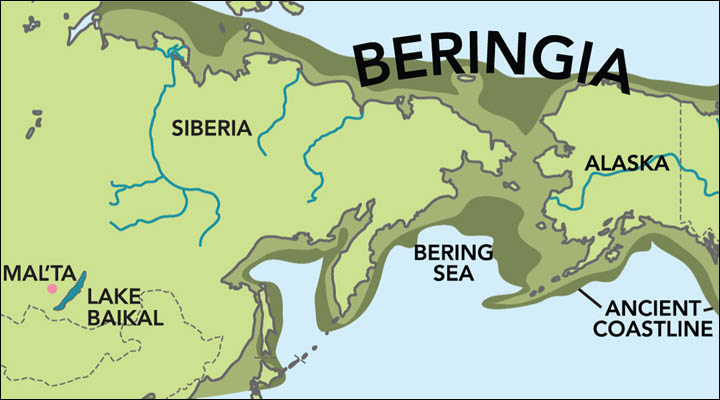
However, the story is not quite so simple as it seems. A recent article in the New York Times suggests that the early speakers of  this language group were long-term residents of Beringia, a land mass that connected Asia and Alaska. This land was a refugium during the last ice age: an environment of trees and grassland unlike the heavily iced north of Asia and North America.
http://siberiantimes.com/PICTURES/SCIENCE/Malta-boy/Beringia%20credit%20G%20Grullon%20Science.jpg
Beringia During the Last Ice Age


When the climate changed, leading to the submerging of their homeland, people who spoke some Dené-Yeniseian language moved both east and west, I'm not sure when. A University of Alaska web page gives useful links to the work so far.


Tuesday, 9 June 2015

The Wisdom of Terry Pratchett, and Police Killings

Terry Pratchett is a name that I had tucked away in the back of my mind for a rainy day. I had come across a quotation of his--"If cats looked like frogs we'd realize what nasty, cruel little bastards they are. Style. That's what people remember"--and, as a true lover of cats, I was struck by the pointedness, the accuracy, and the humour in the quotation. One day, I was sure, I was going to look up this fellow's books and see what else is in them.

That day came a couple of months ago, shortly before Sir Terry died. The Vancouver Public Library provided me with Night Watch, Thud, Snuff, Going Postal, Making Money, Small Gods, and Thief of Time. The Kobo Book Store has since provided me with others. The first three of the books I had mentioned feature Sam Vimes, a watchman (police officer) in a grubby, industrializing city-state called Ankh-Morpork. Ankh is on one side of the river; Morpork is on the other. They combined their names as well as their government just as Buda and Pest did back in 1873.

I like Sam Vimes. I like the fact that he resents the upper classes, even when he increasingly, and unwillingly, is forced to enter them. For example, in Feet of Clay, he looks at the sedan chair that the city's ruler had given him as a wedding present.
Lord Vetinari knew that Vimes loved walking the streets of the city, and so it was very typical of the man that he presented him with something that did not allow him to do so.
Nevertheless, he had to use it. His wife expected it, and Lord Vetinari would have his little joke, but he would use it in his own way. He ordered one of the bearers into the sedan chair and prepared to take the bearer's place.
"'It's a nice morning,' said Vimes, taking off his coat again. 'I'll drive myself.'"
 Similarly, I was charmed by Vimes' detestation of the game of chess, which is explained in a footnote in Thud.
Vimes had never got on with any game much more complex than darts. Chess in particular had always annoyed him. It was the dumb way the pawns went off and slaughtered their fellow pawns while the kings lounged about doing nothing that always got to him; if only the pawns united, maybe talked the rooks round, the whole board could've been a republic in a dozen moves.
This passage reminds me of my dad, although he taught me chess and played it with me on many occasions. We had been living in various places in Whitehorse, Yukon: old RCAF housing then an apartment, but both mum and dad had good jobs, so the time arrived when we bought a new house in the "good" part of town, in Riverdale. My dad seemed a bit upset by the move, though, not happy at all. I asked him why. "Well," he said, "when the revolution comes, we'll be on the wrong side of the barricades."

Now, Terry Pratchett's Discworld, though pure fantasy with trolls, dwarfs, goblins, wizards, dragons, and the like, allowed him to explain his views on numerous issues facing our world: illicit drugs, intolerant religions, secret police, the art of government, and gun ownership. The link between his writings and the subjects of police killings and state-sponsored brutality interests me most right now. There have been a number of well-publicized cases of killings of unarmed men and women, some of them already in restraint, some of them actually running away, and none of them a danger to the officer at the time of the shooting. The FBI keeps track of the fatal shootings that are voluntarily submitted by police departments, but the sum vastly understates the number. A quotation in a Washington Post article, I think, explains why.
“They are used to giving commands and people obeying,” said Stinson, who previously worked as a police officer. “They don’t like it when people don’t listen to them, and things can quickly become violent when people don’t follow their orders.”
That wouldn't be the police officer's point of view in any service run by Sam Vimes. Pratchett explains in Snuff:
It always embarrassed Samuel Vimes when civilians tried to speak to him in what they thought was “policeman.” If it came to that, he hated thinking of them as civilians. What was a policeman, if not a civilian with a uniform and a badge? But they tended to use the term these days as a way of describing people who were not policemen. It was a dangerous habit: once policemen stopped being civilians the only other thing they could be was soldiers.
Can we say that he (whether Vimes or Pratchett) is wrong? I don't think so.

The idea that a police officer is a civilian is odd, to a North American, odd to the point of being disconcerting, but Pratchett is not North American. He is English, very English, and the police in his country were formed according to principles laid down by Robert Peel. One of these is
...police officers are regarded as citizens in uniform. They exercise their powers to police their fellow citizens with the implicit consent of those fellow citizens. "Policing by consent" indicates that the legitimacy of policing in the eyes of the public is based upon a general consensus of support that follows from transparency about their powers, their integrity in exercising those powers and their accountability for doing so.
In other words, policing is a genuine alternative to military intervention, not an alternative way of delivering military intervention.

It is unfortunate, in my opinion, that the origins of the police here in Canada and in the US lie in a different tradition than Robert Peel's. The RCMP's name in French includes the word "gendarmerie," meaning a paramilitary force. Its uniform, too, is based on the British Army's uniform. The American police had a complicated origin but, in the West, the posse, called together by a sheriff, provided armed defence against armed and violent individuals and gangs. Where there was no sheriff, the vigilante or the lynch mob provided the same service. In some parts of the country, the police, vigilantes, and lynch mobs were, at least in part, intended to protect citizens from slaves and minority groups. Nevertheless, it is never too late to keep in mind the ideal that police should think of themselves as civilians who are helping to protect civilians. Not bombing houses from the air in Philadelphia nor drawing handguns on teenagers at a pool in Texas nor firing fifteen shots into a couple through their car window in Ohio.

Sam Vimes had other points of view, well expressed, that coincide with my deepest beliefs. For example, what would he have said to the photographs that came from the US military prison at Abu Gharib?
http://rt.com/files/usa/news/abu-ghraib-scapegoats/abu-ghraib2.jpg
He'd have said this (as he did in Thud),
Beating people up in little rooms...he knew where that led. And if you did it for a good reason, you'd do it for a bad one. You couldn't say we're the "good guys" and do bad-guy things.
(Italics are mine).